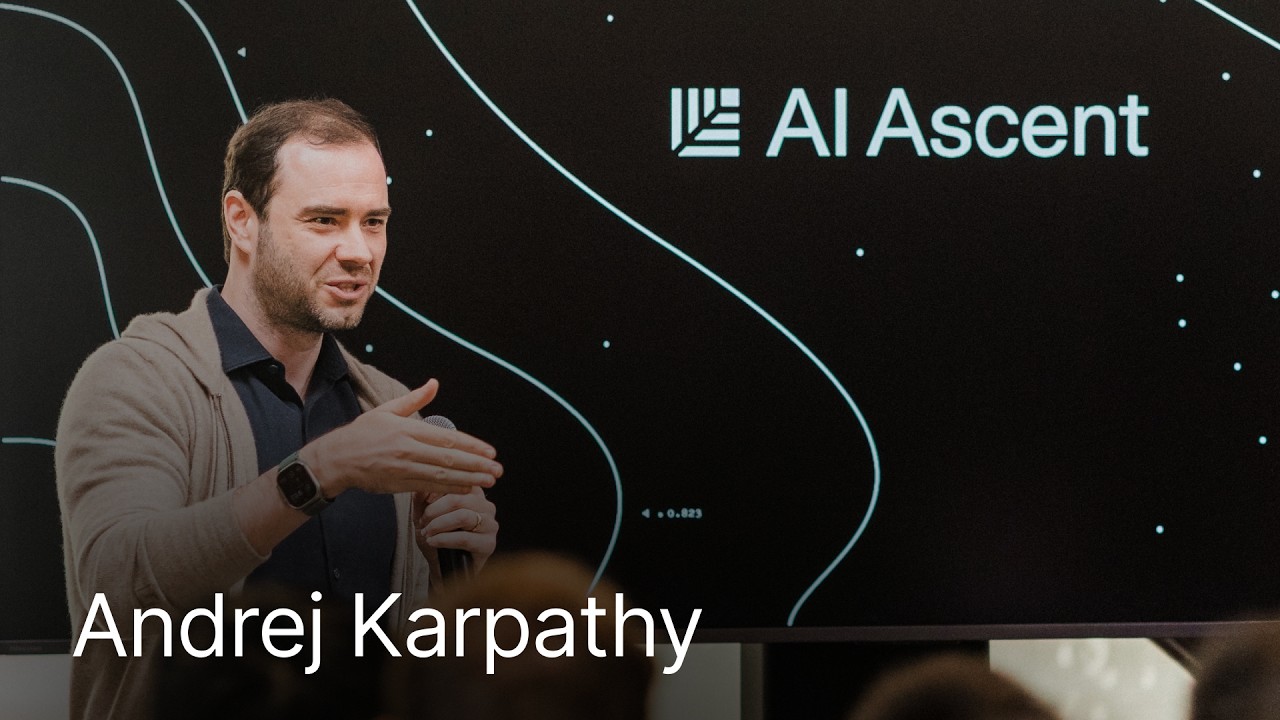
Andrej Karpathy, a prominent figure in AI who previously led Tesla’s Autopilot team and co-founded OpenAI, recently addressed students entering the field. His core message: this is a pivotal moment to jump into AI, because software is once again undergoing a fundamental shift.
He framed this as an evolution through three paradigms. Software 1.0 has been the norm for over 70 years—programmers hand-write explicit instructions line by line. Software 2.0 flipped the script: instead of coding logic, you train a neural network on data, and the resulting weights become the ‘program.’ Early examples like AlexNet were fixed-function classifiers, but large language models broke that mold. They exhibit an emergent programmability: by varying natural language prompts, you can steer the same model to do translation, code generation, or summarization. Karpathy calls this Software 3.0—where prompts effectively become the new programming language.
To illustrate, he drew a parallel between platforms. GitHub is the iconic repository for Software 1.0 source code; Hugging Face is its counterpart for Software 2.0, hosting model weights instead of code files. Each fine-tuned version of a model is akin to a git commit, creating a lineage of variants. He pointed to the Flux image generation model, whose sprawling parameters form a massive ‘codebase,’ with fine-tunes branching like software forks. This shift demands entirely new tools, collaboration models, and mental frameworks.
Not everyone agrees. Skeptics argue that neural nets are statistical models rather than deterministic software—their outputs can be unpredictable, and debugging them is notoriously opaque. Others note that prompt-driven programming has limited scope, unable to replicate the precision and complex state management of traditional coding in many mission-critical applications. Still, Karpathy’s emphasis is on potential: the ecosystem is already reshaping itself around prompt engineering, model fine-tuning, and autonomous agents.
Regardless of how you label it, a vast amount of legacy software is being rethought and rewritten from the ground up. For newcomers and experienced developers alike, this represents an unprecedented landscape of opportunity, with new toolchains and design philosophies coalescing in real time. Karpathy’s overarching message is optimistic: AI isn’t shrinking the scope of human creativity in code—it’s opening a new frontier that demands we reimagine what programming can be.

![[1hr Talk] Intro to Large Language Models](https://i.ytimg.com/vi/zjkBMFhNj_g/maxresdefault.jpg)