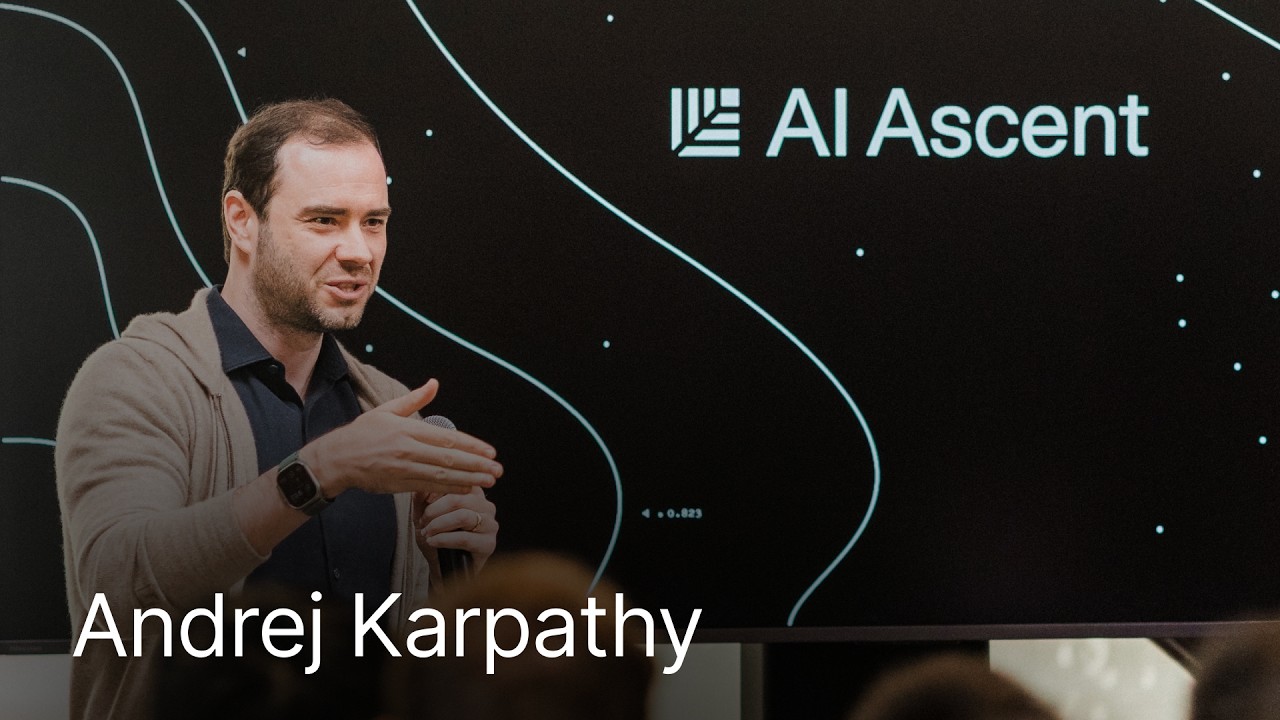
Andrej Karpathy opens with a vivid metaphor: an AI Agent is like a person who needs both legs—tools and memory—to walk steadily. Without either, the whole thing stumbles. It’s a refreshingly direct way to cut through the hype that has inflated Agent discussions over the past year. Karpathy, former Tesla AI head and OpenAI co-founder, now runs his own education‑focused venture, and he has a gift for translating complex ideas into intuition.
His central argument is straightforward: a large language model (LLM) is just a “brain.” However brilliant its reasoning, it’s useless without hands and a notepad. So what makes an Agent is the addition of a tool‑use layer and a memory system outside the model. Tool‑use lets the model call search engines, Python interpreters, APIs, or other software—moving beyond mere text generation. Memory splits into short‑term (keeping context within a single task) and long‑term (accumulating knowledge across sessions), turning the system into a genuine personal assistant. Karpathy anchors this in the longer arc of digital automation: from hard‑coded rules, to RPA that shuffles data along fixed paths, to today’s Agents that plan steps and choose tools on the fly. It’s the evolution of automation from “muscle” to “brain.”
He makes the ideas concrete through examples. Booking a flight: the Agent first queries a search engine, stores results in short‑term memory, then calls a price‑comparison API, and finally writes an event to the calendar—each step demanding tool use and memory. Without them, the model just hallucinates a flight number. Or writing a report: the Agent searches, reads pages, creates summaries saved in long‑term memory; days later, when the user asks for additions, it retrieves those stored notes rather than starting from scratch. This capability doesn’t come from stacking more parameters; it’s an external scaffold. Karpathy also touches on model selection: bigger isn’t always better. A fine‑tuned mid‑size model with a well‑designed toolchain often outperforms a bare 175‑billion‑parameter giant—more reliable, cheaper, and easier to debug.
He doesn’t shy away from the downsides: these new “legs” are still wobbly. Tool calls can fail—malformed API requests, poor search queries—and memory can accumulate errors, gradually poisoning the agent’s behavior. Worse, once you grant an Agent real operating‑system privileges, a single mistaken terminal command could mean data loss. Karpathy’s take is that we can’t just wait for smarter models; the architecture of tools and memory itself must include sandboxing, verification, and rollback. This echoes a broader industry refrain: alignment isn’t something you postpone until AGI arrives—it’s part of the process. His 5‑year outlook is intriguing: tools will become standardized, like today’s plugin ecosystems, but memory will be the true moat. Whoever first cracks reliable accumulation of personal or enterprise memory will lead the Agent‑commercialization race.
Wrapping up, Karpathy returns to a simple takeaway: stop obsessing over AGI. An Agent isn’t some mystical breakthrough; it’s just an engineering extension of what models can already do. The distance those two legs—tools and memory—can carry us depends on the roads we build for them, not on waiting for an omniscient brain to descend. No slides, no paper‑reading, just plain talk. By the end you understand exactly why he titled the session “Tools + Memory: The Two Legs of an Agent.”


![[1hr Talk] Intro to Large Language Models](https://i.ytimg.com/vi/zjkBMFhNj_g/maxresdefault.jpg)