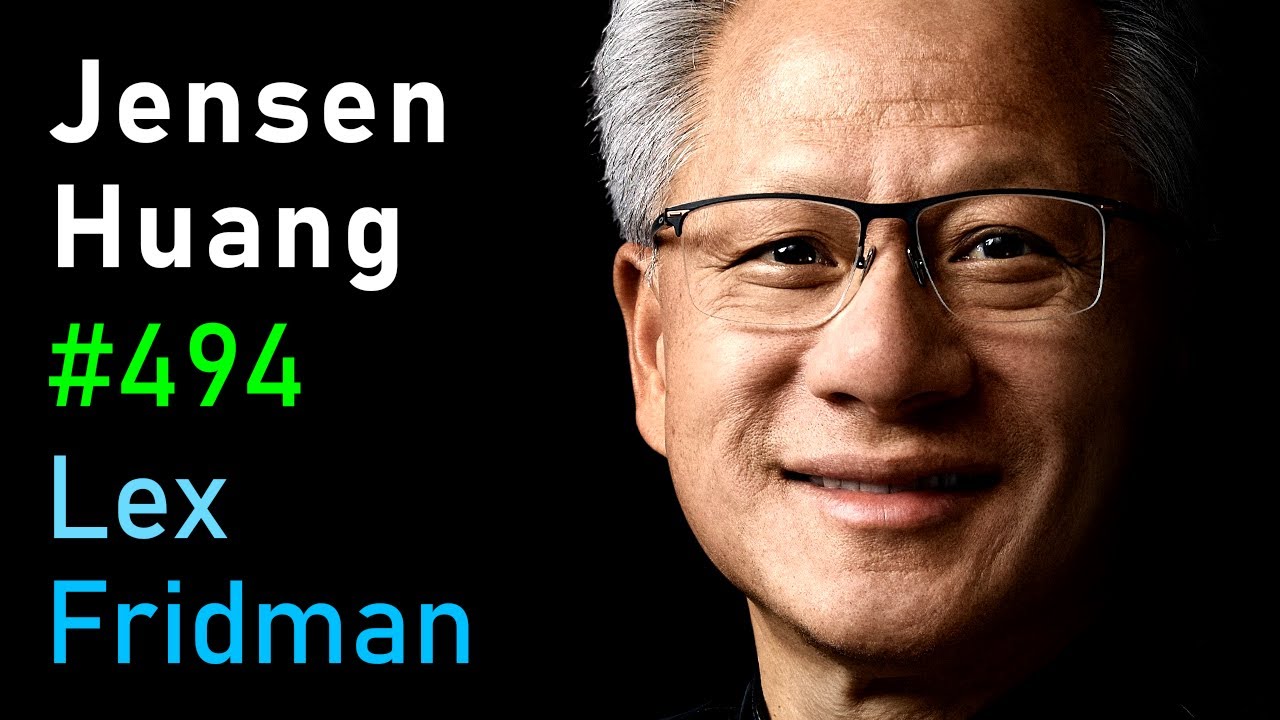
Jensen Huang, NVIDIA's founder and CEO, recently sat down for a deep-dive interview that wasn't about product launches or financials—it was a philosophy lesson on computing. He laid out his vision of a future where everything is robotic, powered by the GPU. The core story is how NVIDIA evolved from a gaming graphics company into the world's most important AI hardware supplier.
It started in the 1990s. Game developers wanted more realistic graphics, but traditional CPUs (central processing units) are great at sequential tasks, not the massive parallel math needed for real-time 3D rendering. Huang's team noticed that roughly 10% of code does 99% of the work, and that 99% can be done in parallel. So they designed a new architecture that handles both sequential and parallel workloads—the foundation of the modern GPU. They targeted gaming first because it demanded real-time 3D graphics and had a huge market to fund R&D, creating a flywheel: better tech → better games → more sales → more R&D.
Huang repeatedly calls the GPU a "time machine." He tells the story of a quantum chemist who, thanks to NVIDIA GPUs, could complete his life's work in a single lifetime—simulations that would have taken generations. Parallel computing speeds things up by orders of magnitude, letting researchers "see the future" in weather prediction, self-driving car simulations in virtual cities, and molecular dynamics. The key enabler was the CUDA platform, launched in 2006. Early researchers had to trick GPUs into thinking their problems were graphics tasks. NVIDIA saw both external demand (medical imaging, physics) and internal need (water flow, explosions in games) and made CUDA, allowing programmers to use familiar languages like C to directly program GPUs. This lowered the barrier dramatically, unleashing a wave of non-graphics acceleration—deep learning, quantum chemistry, fluid dynamics—that reshaped entire fields.
Of course, there are counterpoints. Critics worry about NVIDIA's near-monopoly in AI training chips, raising supply chain and pricing concerns. Massive data centers consume enormous electricity, straining the environment. High GPU costs could widen the gap between haves and have-nots in AI capabilities. Job displacement fears persist. Some argue the current AI boom relies too much on brute-force compute without fundamental breakthroughs. Huang himself avoids finance, management, and politics, focusing on technology as a problem-solving tool. His techno-optimism assumes that understanding possibilities will inspire constructive action.
The interview traces a clear arc: from playing games to building a time-machine-like tool, then to physical AI and robot training—teaching machines to interact with the real world. Huang believes everything will become robotic, and the Transformer architecture (the basis of today's large language models) will keep evolving, pushing AI's boundaries. His advice to learners: understand the fundamentals, don't just chase hype. NVIDIA's story is ultimately a parable about how solving a specific problem (game graphics) accidentally unlocked the future of computing.