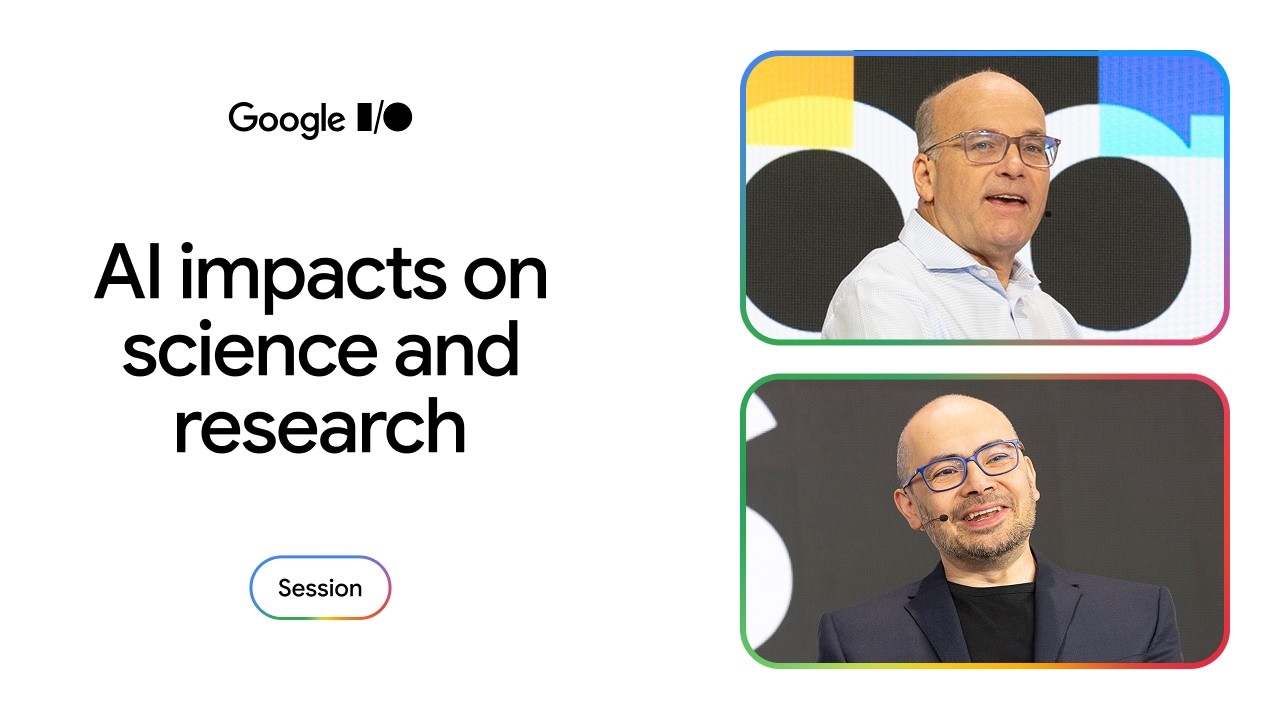
Demis Hassabis, founder and CEO of DeepMind, recently delivered a lecture at the Crick Insight Series titled “Using AI to accelerate scientific discovery.” You might know him as the chess prodigy who later studied neuroscience at Cambridge before building a company that taught computers to play Atari games and beat the world champion at Go. But his obsession now is a much bigger question: how do the algorithms forged in virtual playgrounds turn into an accelerator for scientists, helping them discover new drugs and materials faster? In the talk he gave a blunt timeline: by around 2027 we will see AI systems routinely performing tasks at the level of a doctoral researcher. That is not science fiction; it is a pragmatic reading of the technology curve he has been riding.
He dislikes definitional debates about AGI. The threshold for “powerful AI,” as he calls it, is simply this: doing PhD‑level work—reading the literature, designing experiments, analyzing data, proposing hypotheses—consistently and reliably. Once that bar is cleared, even if someone protests “but it is still not AGI,” the floor drops out from under pharma, materials and energy. Demis’s own CV is the annotation. From a neural net learning to play Space Invaders to AlphaFold cracking a 50‑year grand challenge in biology, every step has been about transplanting intelligence trained inside a game engine onto real‑world complex systems. As he puts it, games offer a perfect test bed—action sequences, reward signals, colossal search spaces—which happen to be the abstract structure of scientific discovery itself.
Then he took apart the technical pipeline. AlphaGo’s Monte Carlo tree search, designed to project win‑loss paths on a board, was later repurposed to seek lowest‑energy states in molecular conformation spaces. AlphaZero’s self‑play, which learned superhuman strategies without any human game records, is now being used in materials genomics to autonomously combine elements from the periodic table and predict new superconductors or catalysts. He mentioned almost in passing that DeepMind has assembled an internal “science‑discovery engineering” stack: generative models to augment scarce data, self‑supervised pre‑training to capture physical and chemical regularities, and reinforcement learning to drive exploration. Many observers worry about the chip wall, but Demis sees compute as a physical bottleneck that will not bite before 2027. The true constraints, he argued, are data quality, algorithm efficiency, and organizational capacity—and they are thinning each one.
He did not talk only of acceleration, though. Halfway through the lecture he lifted up safety with a counter‑intuitive punch. The standard instinct is to build more powerful systems first and figure out control later. Demis shook his head: alignment research is not an add‑on for after AGI; it has to be baked into the process from the start. From early reinforcement learning from human feedback (RLHF) to Constitutional AI, he and his team have turned alignment into an engineering mechanism that evolves with the model. On the business side the same restraint shows: he chose an API‑first model, supplying base cognitive capability rather than racing into consumer applications. The bet is that the application layer will flourish in the ecosystem, but the hidden cost is that if a downstream player misuses the technology, the feedback loop for fixes gets longer—so they embed safety guardrails right at the API. More work now to avoid a patchwork later.
He wrapped up by laying his cards on the table: in the next five years, the goal is not to win the AGI race but to be first on the safety curve. He made a deliberate nod to policy, framing export controls not as a way to halt progress but as a means to buy a few extra years for alignment research. Many students in the audience might still wonder how gaming could become a science accelerator. What Demis really wanted them to take away is this: what he learned bent over a chessboard and a videogame console was not just a handful of algorithms; it was an entire engineering culture of fast iteration and continuous optimization. On the scale of scientific exploration, that culture has become the scarcest fuel. Five years from now, AlphaFold may look like a prologue. The real story will be how a set of methods forged repeatedly inside virtual worlds ended up putting humanity’s hardest real‑world problems on fast‑forward.


![[AI DAILY NEWS RUNDOWN] Open AI Guardrails Obliterated, Hassabis Warns of 2029 AGI, and the Pope’...](https://i.ytimg.com/vi/UwSqB8oP8dg/maxresdefault.jpg)